

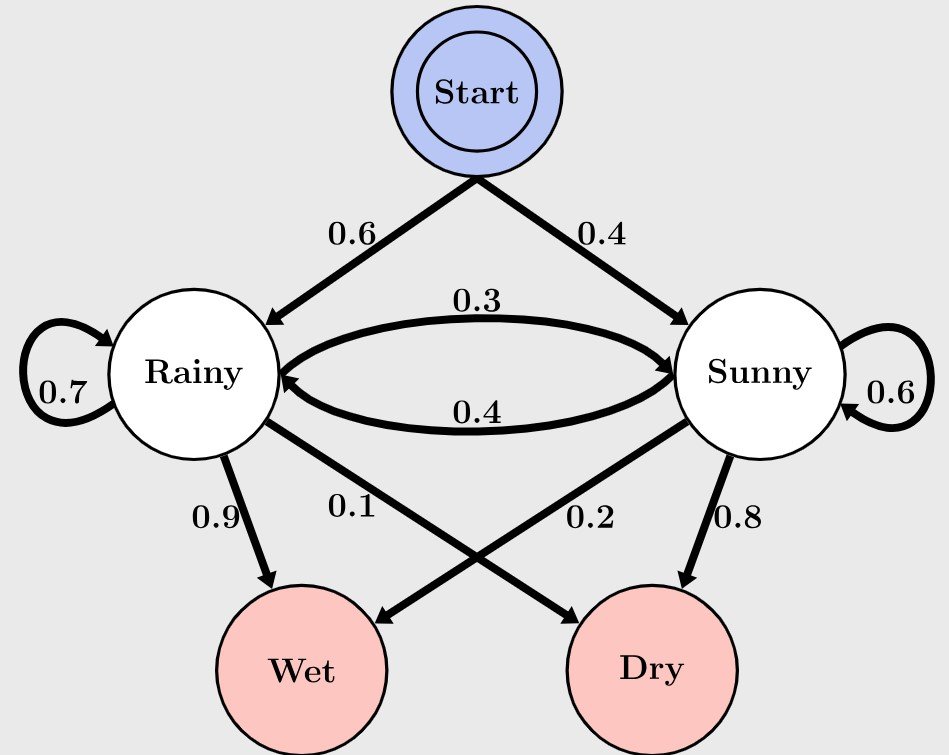
Many real-world systems behave like puzzles where you can see the outcomes but not the underlying causes. You hear spoken words but cannot directly observe the speaker’s intended phonemes. You watch stock prices move but cannot see the hidden market “mood” driving those shifts. You monitor machine vibration signals but cannot directly observe the internal wear state of a bearing. Hidden Markov Models (HMMs) were designed for exactly these situations. They model a process that moves through a sequence of internal states that are not directly observable, while producing observable outputs at each step. By modelling the relationship between hidden states and observed signals, HMMs help us infer underlying dynamics and predict future states.
What Makes an HMM “Hidden”
Observations vs. States
In a standard Markov process, the system’s state at time t is visible, and the “Markov property” says the next state depends only on the current state, not the full history. In an HMM, the state is hidden. Instead, you observe emissions, meaning signals generated by the hidden state. An HMM therefore has two parallel sequences: a hidden state sequence and an observed sequence.
The Three Core Building Blocks
An HMM is typically defined by three elements:
- Initial state probabilities: the likelihood of starting in each hidden state.
- Transition probabilities: how likely the system is to move from one hidden state to another between time steps.
- Emission probabilities: how likely each observed output is, given a particular hidden state.
Together, these define a compact probabilistic “engine” that can describe complex time-dependent behaviour.
Key Problems HMMs Solve
1) Likelihood Evaluation
Sometimes you want to know how well a model explains observed data. Given an HMM and a sequence of observations, you can compute the probability of observing that sequence under the model. This is useful when comparing different models or detecting whether a sequence looks “normal” for a given system.
2) Decoding the Most Likely Hidden State Sequence
A central question in HMMs is: given the observations, what hidden states most likely produced them? This is often called decoding. In practical terms, decoding helps you infer invisible conditions, such as whether a customer is in a “high intent” vs. “low intent” state based on their browsing behaviour, or whether speech audio corresponds to particular phoneme patterns.
3) Learning Model Parameters from Data
In many applications, you do not know the transition and emission probabilities in advance. HMMs can learn these parameters from sequences of observations. This is what makes them so useful in domains where labels are scarce or hidden states cannot be directly measured.
Learners who explore probabilistic modelling in an ai course in bangalore often encounter HMMs as a stepping stone to modern sequence models, because HMMs teach structured thinking about time, uncertainty, and latent variables.
Where Hidden Markov Models Are Used
Speech and Language Processing
HMMs have a strong history in speech recognition, where the acoustic signal is observable but the linguistic units are hidden. Even in modern pipelines that use deep learning, the conceptual framing of hidden states and emissions remains valuable for understanding how sequential signals can be structured.
Predictive Maintenance and Industrial Monitoring
Sensors provide observable signals such as temperature, vibration, and pressure, but the machine’s true health state is hidden. HMMs can model health as hidden states, such as “healthy,” “degrading,” and “critical,” while emissions correspond to sensor patterns. This supports early warning systems and maintenance planning.
Finance and Behaviour Modelling
Markets and users both exhibit regimes. A market can shift between volatility regimes, and customers can shift between engagement modes. HMMs can help detect regime switches by modelling these regimes as hidden states and the observed data as emissions.
For professionals building real-world AI systems, an ai course in bangalore can be useful when it emphasises not only algorithms but also how to map business signals into formal probabilistic structures like HMMs.
Strengths and Limitations of HMMs
Strengths
- Interpretability: Hidden states can often be given meaningful labels (e.g., “low risk” vs. “high risk”).
- Data efficiency: HMMs can work well with smaller datasets compared to many deep learning approaches.
- Structured reasoning: They provide principled ways to compute likelihoods, infer states, and learn parameters.
Limitations
- Simplifying assumptions: The Markov property and conditional independence assumptions may not hold in complex systems.
- State design matters: Choosing the number of hidden states can be difficult, and too many states may overfit.
- Performance ceiling: For highly complex sequence tasks, modern neural sequence models may outperform HMMs, though they can be less interpretable.
Conclusion
Hidden Markov Models remain a practical and conceptually elegant tool for modelling sequential systems with hidden structure. They allow you to infer invisible states from visible signals, evaluate how well a model explains observed sequences, and learn system dynamics from data. Whether applied to speech, machine monitoring, customer behaviour, or regime detection, HMMs offer a disciplined framework for reasoning under uncertainty. Understanding them builds strong foundations for more advanced sequence modelling, and it also improves how you approach real-world problems where the most important variables cannot be observed directly.
